Southern Legitimacy Statement: After attending high school in central Mississippi, I was determined to leave the South. I went to school for radiology, only to realize I envied the people doing the landscaping around the hospital property. I realized all I wanted was to be outside, so I bailed and joined a trail crew instead. I fell in love with working outdoors, bouncing around the country doing seasonal work, and I eventually landed in Durham, North Carolina, where I currently work for a farming nonprofit.
Water Witching
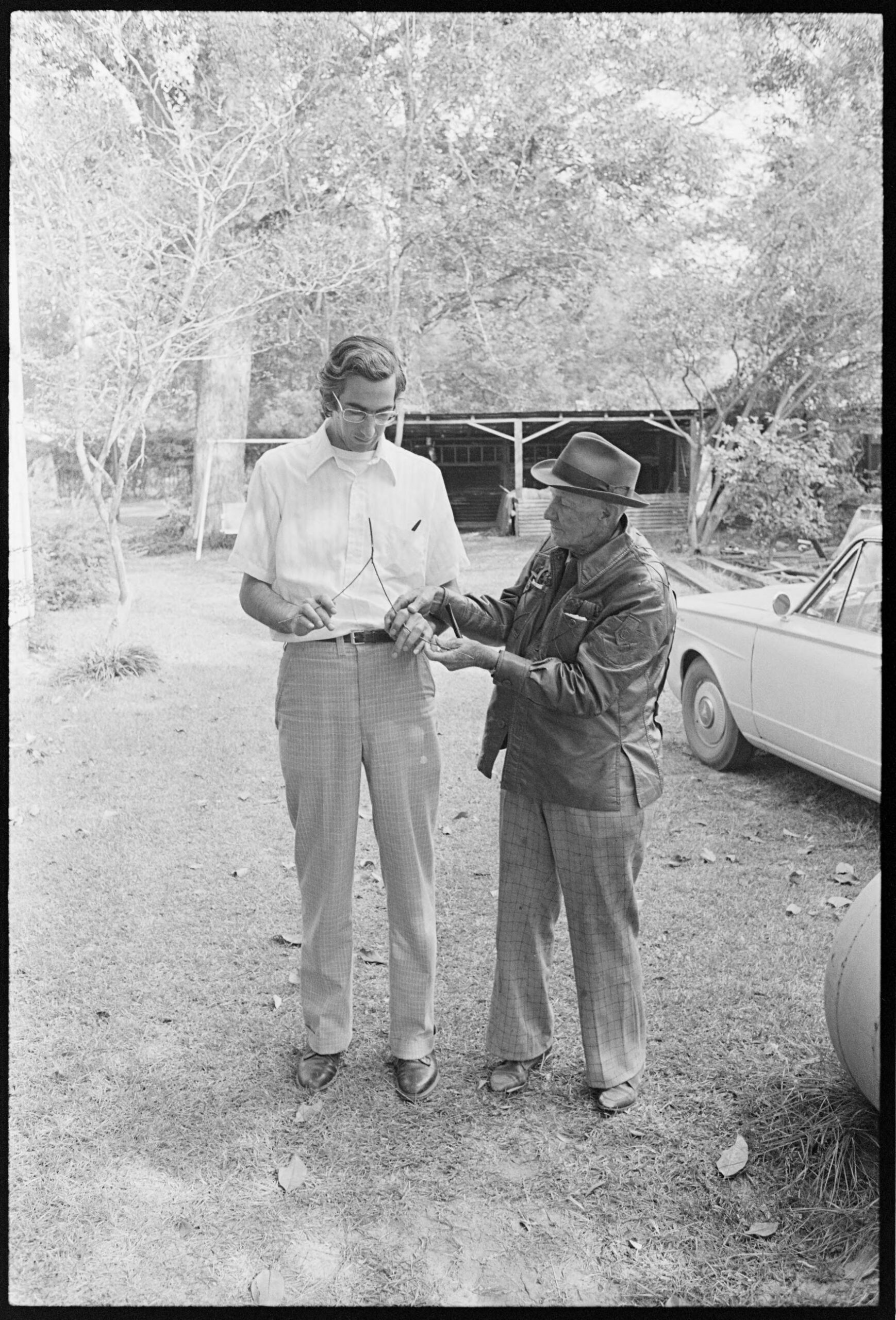
Pop tramples across the desert, his boots kicking dust through Mr. Jackson’s land. He grimaces and lowers the brim of his cowboy hat to shade his eyes from the burning sun. He resumes holding his two L-shaped sticks before him, his tan, rough arms outstretched, steady and horizontal. The wind tugs my hat as I struggle to keep his pace. The L-shaped sticks are still parallel with one another, but my skin prickles and I feel my heart skip a beat as Pop faulters. He moves forward slowly, cautiously, and watches the two sticks cross.
“You think it’s just the wind, pop?” I catch my breath and wince as I tighten my belt on the fourth notch. These days, my jeans have been loose, and my belt is either too tight or not tight enough. The fourth notch does it now, but it strains my waist and makes my spine sore.
Pop shakes his head and grunts, “Nope. They’ll dig right here.”
Pop stacks a pile of rocks over the earth where the sticks crossed paths. He pulls out a silver flask from his breast pocket and swigs his whiskey. Not one muscle is pulled on his face and I’m certain he lost the ability to taste liquor anymore. Then he lights a cigarette, which after taking a long drag from, he holds between his cracked fingers. It creates an illusion like a pistol, the cursive smoke billowing through his pointed fingertips and disappearing in the sunlight. I watch Pop smoke for a minute, and it reminds me of a time when he passed out at the table and I stole a cigarette from his pocket. Curiosity got the best of me and when I lit it in the backyard, I had a devilish coughing fit. It woke him up, but he didn’t catch on to what I’d done. He just thought I finally caught the same sickness that took my mother.
The rich spice of tobacco wafts through the air and Pop turns around, his boots kicking dust as he walks back to the truck.
“That’s it? That’s all there is to it?”
Pop nods.
“How will Mr. Jackson know that pile of rocks is where you want him to dig? There’s other piles of rocks out here too.”
“You ask too many questions, girl.” Pop says. “Why can’t you be more like Sue? She’s quiet and polite.”
I bite my tongue and trail behind him to the truck, tending to my sore inquisitiveness like a wounded creature. There aren’t enough answers in this world for all I’ve got to ask, but I feel like that doesn’t make my questions not worth asking. Sue and I are friends, but I hate when Pop pits me against her with the beast that is comparison. It isn’t Sue’s fault, but I begin to resent her for the perfection Pop sees in her.
We drive past the withering corn stalks; they are bent like the spines of old people at church. The remnants of cabbage rots in the fields, their cores plucked clean by the dark birds.
“Why do you smoke, Pop?”
“If I told you, you’d take up the habit too.” He rolls the window down, flicking the butt of his cigarette out the window as if to discard the evidence.
I don’t understand why he’d say a thing like that, but I refrain from asking any other questions.
A few weeks later, Mr. Jackson digs a well exactly where Pop stacked those rocks and sure enough, Pop was right. When they first strike water, it’s thick as blood and muddled with sediment, but at the end of the day, no one complains.
The year goes by, and summer turns to fall, and fall into winter. The cold whips against our brittle skin and chapped lips. No amount of newspaper is enough to stuff and insulate the cracks of our cabin. We pry off rotten, warped floorboards with bloodied fingers and pound the same rusted nails back into the new boards. On Christmas day, Pop buys me a new corduroy coat and I don’t question where he got the money from. It could be from the witch, for all I know.
I wear my coat proudly, knowing I look twice as nice as the Wesley twins down the street. Only difference is that I’m a girl that dresses like a boy, so those brothers don’t think I look very nice at all. I once heard their mother whisper that since my mother died, I got myself all confused in the head. My pop didn’t know how to dress me better. Mrs. Wesley said that he didn’t have the woman’s touch. It took me a few years to understand what that meant.
A few years pass and Pop gives up cigarettes. He doesn’t give up the whiskey.
I go into the tenth grade. Sue gets a boyfriend; his name is Paul. He’s a grade older than us. Pop asks why I don’t have a boyfriend yet. Sue emerges as the pinnacle of academic excellence, while my grades remain below average.
I go into the eleventh grade. Sue goes to the school dance with Paul, while I volunteer at the door to make up for my poor grades. She rests her head on his shoulder but looks my way. Later, I cry in the storage closet. Pop comes by to pick me up from the dance and asks when Paul is going to put a ring on Sue’s finger.
I go into the twelfth grade. Sue tells me she’s signing up for an elective class on home economics. I don’t care about the customs of domestic life, but I take the class so we can pass notes back and forth. I pay enough attention to know the answers to our tests, but I pay more attention to the way I feel when Sue winks and shows me her answers. At the end of the school year, she passes the class because she studies hard, and I pass the class because she shows me her work.
Pop’s off working late the evening before we’re set to graduate. I take some of his whiskey and meet Sue down by the creek behind the church. The taste is so horrible, but a feeling burns inside me that only the alcohol can dare to match.
“Your daddy’s job ain’t a real job.” Sue says, smiling at me as if she knows something I don’t.
“Sure, it is, he works hard. Water witchin’ works.”
Sue shakes her head. “Water witchin’ ain’t holy and anyway, the devil works too, you know.”
As she patiently waits for my retort, she chews on her lower lip and studies my expression. Her ignorance makes my cheeks burn red.
“Well, your Pop didn’t save my mother, so how’s that for having a real job? He ain’t holy either, remember years ago when I was supposed to get stitches for falling out the tree behind school? Well, Sue, you’ll never believe it, but I saw him feeling up his nurse’s skirt. I swear I saw him do it.”
Sue bolts to her feet, exhaling sharply. She opens her mouth to speak her mind, but with sudden better judgement, her lips tighten. She regains her seat. “You think I don’t know about that?”
“Did you?”
Sue nods but seems uneasy. “Well, nobody’s perfect.”
“Your parents ought to get a divorce.”
Pale as the moon, Sue frowns. Her trembling hands hide beneath her dress. “Jean, say another word about my parents, and I’ll leave you.”
I change the topic, “Pop’s job is a real job.”
Sue turns away from me and doesn’t reply, only shaking her head in disagreement. After a few minutes of silence, she asks, “What are you going to do when we graduate tomorrow?”
“I’m going to get out of town.”
“Dressed like that?” Sue says, not disgusted, only concerned.
“What do you mean, dressed like that?”
“Well, I mean, people might be used to the sight of you here, but where else in the world would they see a girl like you?”
I bite my tongue, knowing Sue’s not wrong to question my unusual appearance. I feel sick and I’m not sure whether it’s the pungent whiskey or my own, uncomfortable, festering shame. I think of Mrs. Wesley and my face grows hot, wishing the dark scavenging birds of the fields might sweep into her house at night and pluck her eyes out. Then, she couldn’t see me anymore and say mean things about me.
Sue sees the trouble in my eyes and she puts her hand on the back of my neck.
“You’re going steady with Paul still?” I ask, changing the topic and nudging her hand away.
Sue nods. She’s hesitating and I know there’s something she’s not telling me, but she turns the attention away from herself, “When will you find a boy?”
“I won’t. I won’t ever.”
“They’ll come around to you.”
“No, they won’t. I won’t let them. I’ll kill them.”
“Jean!” Sue slaps my shoulder playfully, her eyes widening.
“I’ll kill them.” I reaffirm.
Sue looks at me with a pitiful expression and something desperate flickers in her eyes, but she glances away. I stare at my shoes as though the laces could hold my heart from breaking.
I clear my throat. “What about you? Are you going to move away?”
Sue only answers with a sad smile. I know she’s too attached, too secure, to consider leaving. Her gaze lingers on my face for a painfully long, quiet moment. Then, as though this moment had played out before in her mind, she stretches out her hand and hovers near my face. And like the moment had unfolded before in my own dreams, I lean in. She slowly traces over my brow, my temple, my cheek, my jaw, my chin. Her fingers are trembling again, but she steadies them as though she’s remembering every curve of my skin for the last time. Without hesitation, Sue leans forward and plants a gentle, warm kiss on my tensed lips.
When Sue pulls away, she isn’t surprised by what she’s done. She’s not disgusted by me; she doesn’t cast the same judgmental stares the Wesley twins do. A single tear blooms in her eye and rolls down her cheek. She stands up.
“You’ll leave this town, Jean, but I never will.”
“Why not?” I bolt to my feet, brushing sand from my pants.
“I was never meant to. You were.”
“What makes you think I was meant to leave here and you weren’t?”
“Because I feel it. I feel that you’re going to leave. And when I try to feel it for myself, I feel absolutely nothing. I’m not cut out for the sort of life I know you’ll go on to live and you weren’t cut out for mine.”
I reach out for Sue’s hand and embrace her for a moment, running my thumb along her palm. She turns away from me on the verge of tears.
When I walk home, Pop’s truck is parked outside the cabin. He’s home early and he knows I took his whiskey. He shouts about how I’ll never amount to anything, how I don’t fit in and how I’m not like other girls. He asks why I’m not more like Sue. Her name becomes a knife in his mouth, slicing through my soul until my chest caves in.
While Pop sheds off his frustration, I fight back tears, not because of his anger, but because of the overwhelming absence of Sue. I know what she’s told me is true; when we graduate, I will leave town and she will stay.
I remember the L-shaped sticks from my childhood and wonder if I could make some money wandering across the country, my arms stretched parallel with blind faith, praying deep down that the sticks will cross, and water will be found. Then again, I’ve never prayed in my life.